Indian mutual fund flows in April 2026 reflected a continuation of resilient domestic investor participation across asset classes despite an uncertain global backdrop marked by persistent geopolitical tensions. Equity-oriented funds continued to attract healthy inflows as investors used phases of market volatility and correction to gradually build long-term exposure to equities. At the same time, debt-oriented categories witnessed a sharp rebound following the fiscal year-end liquidity adjustments seen in March, while gold ETFs continued to garner steady allocations as investors maintained exposure to defensive and diversification-oriented assets.
Equity Funds Continue to Witness Healthy Participation
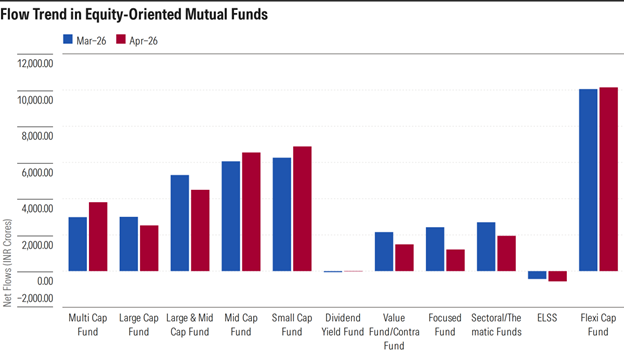
Equity-oriented mutual fund categories continued to witness healthy investor participation in April 2026, garnering net inflows of INR 38,440 crore. While the inflows were marginally lower than the INR 40,450 crore recorded in March 2026 (a decline of about 5%), the overall trend indicates sustained resilience in domestic investor sentiment despite the prevailing uncertain global environment and intermittent volatility in equity markets. The continued strength in flows reflects investors' long-term confidence in Indian equities, supported by steady SIP contributions and continued allocation toward mutual funds as a preferred investment avenue. Importantly, despite the relatively lower net inflows on a month-on-month basis, the industry added approximately 1.41 million folios during April, highlighting continued broad-based retail participation and sustained investor engagement with equity mutual funds.
Source – AMFI Website
The month continued to be characterized by heightened global uncertainty amid geopolitical tensions in the Middle East, fluctuating crude oil prices, and concerns around the global growth and interest-rate outlook. However, domestic investors largely looked beyond the near-term volatility and continued to deploy capital into equities, viewing market corrections and consolidation phases as an opportunity to invest from a long-term perspective.
A key highlight during the month was the continued strength in inflows into the mid-cap and small-cap categories. Mid-cap funds received net inflows of around INR 6,551 crore, while small-cap funds attracted approximately INR 6,885 crore, both witnessing an increase over March 2026. The sustained traction in these categories suggests that investors continue to remain constructive on the long-term earnings growth potential of broader market segments despite elevated volatility and valuation concerns. Improved risk appetite among retail investors and correction-led opportunities also supported flows into these categories.
Flexi-cap funds once again remained the largest contributor to overall inflows, attracting INR 10,148 crore during the month. The category continues to benefit from investors' preference for diversified and flexible investment strategies that allow fund managers to dynamically allocate across market capitalizations depending on opportunities and market conditions. Multi-cap funds also witnessed stronger inflows during the month, indicating continued investor preference toward diversified equity allocation strategies.
In contrast, flows into large-cap funds, large & mid-cap funds, value/contra funds and focused funds, moderated compared with March 2026. This could partly indicate some profit booking amid the uncertain global backdrop. Nonetheless, these categories continued to witness healthy net positive flows, reflecting that investors are still maintaining allocations across different investment styles and market segments.
Flows into the sectoral/thematic category also moderated during the month. While the category continued to witness net inflows of INR 1,949 crore in April, the pace of inflows slowed meaningfully compared with previous months. This suggests that investors are increasingly preferring diversified investment mandates over concentrated sectoral or thematic strategies, allowing them to better navigate market uncertainty and capture opportunities across broader segments of the market.
Dividend yield funds and ELSS funds were the only two categories to witness net outflows during the month.
Overall, the April 2026 flow trend highlights that domestic participation in Indian equities remains structurally robust despite global uncertainties and market volatility. The continued strength in flows toward broader market and diversified categories suggests that investors continue to maintain a long-term constructive outlook on Indian equities and are increasingly using periods of correction and volatility to incrementally build exposure through mutual funds.
Debt Funds Witness Sharp Rebound Following Fiscal Year-End Outflows
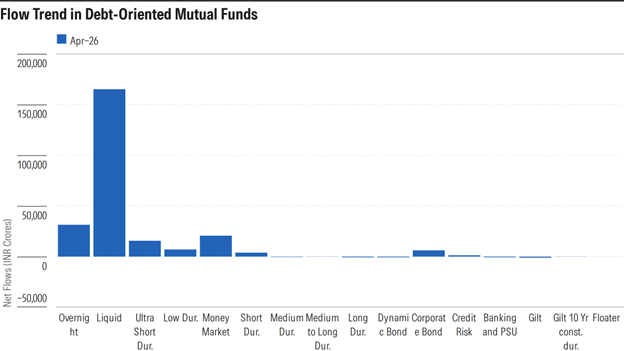
Debt-oriented mutual fund categories saw a strong rebound in April 2026, with net inflows of INR 247,490 crore, sharply reversing the heavy outflows recorded in March. The recovery was largely driven by a normalization of quarter-end liquidity conditions, as institutional and corporate investors redeployed cash that had been temporarily withdrawn in March for fiscal year-end requirements.
Source – AMFI Website
As seen during previous post quarter-end periods, the rebound was overwhelmingly concentrated in liquidity and short-term treasury-oriented segments. Liquid Funds led the recovery with substantial inflows of INR 165,105 crore, followed by Overnight Funds, which saw net inflows of INR 31,420 crore. Money Market Funds also witnessed strong inflows of INR 20,643 crore, partly reversing the sharp outflows seen in March. The flow reversal reinforces the view that fiscal year-end cash management requirements, rather than any structural shift in fixed-income sentiment, were the primary drivers of the recent volatility in flows.
Low Duration Funds also recorded net inflows of INR 7,093 crore, indicating a selective return of investors to short-maturity accrual strategies offering better carry without meaningfully increasing duration risk. Short Duration Funds also turned positive, with inflows of INR 3,917 crore, suggesting some incremental reinvestment beyond pure liquidity products as cash balances normalized.
Credit Risk Funds recorded modest inflows of INR 1,318 crore, marking one of the first instances of net inflows into the category in nearly three years, after having remained in persistent outflow since March 2023. That said, allocations remain selective and modest relative to historical cycles, reflecting continued investor caution toward lower-rated exposure.
In contrast, duration-oriented strategies continued to face pressure. Medium Duration, Medium-to-Long Duration, Long Duration, Dynamic Bond Funds, and Gilt Funds all saw continued net outflows in April, underscoring persistent investor caution toward extending duration amid uncertainty around the timing and trajectory of interest-rate cuts.
From a broader perspective, April's strong inflows appear to represent a normalization following March's fiscal year-end outflows. Investors remain positioned at the shorter end of the curve, with liquidity management and capital preservation continuing to dominate asset-allocation preferences.
Gold ETFs Continue to Attract Steady Allocations
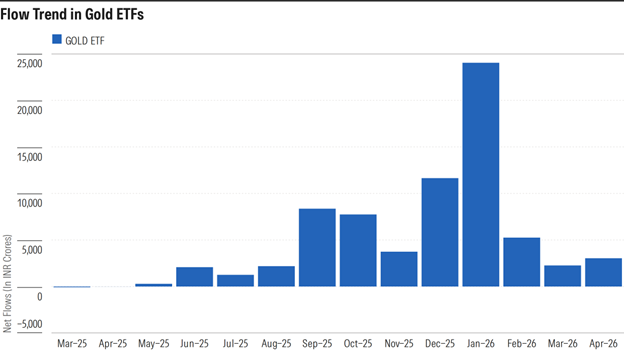
Gold ETFs continued to witness net inflows in April 2026, with the category recording inflows of INR 3,040 crore. While this represents a modest pickup from March's inflows of INR 2,266 crore, the pace remained well below the exceptionally strong inflows seen earlier in the year, particularly in January.
Source – AMFI Website
The improvement in April flows appears to reflect steady, incremental demand rather than any sharp rise in risk aversion. With fiscal year-end adjustments behind, investors likely resumed measured allocations to gold as a diversification tool amid ongoing global and macro uncertainty. Some inflows may also have been supported by gold's continued strength as a hedge against volatility and geopolitical risks, even as broader market conditions stabilized.
From a broader perspective, cumulative inflows for the first four months of 2026 remain strong, underscoring gold ETFs' continued relevance in investor portfolios. While monthly flows have normalized from January's peak, the persistence of net inflows suggests that gold is increasingly being held not just as a tactical hedge, but as a strategic allocation within diversified portfolios.